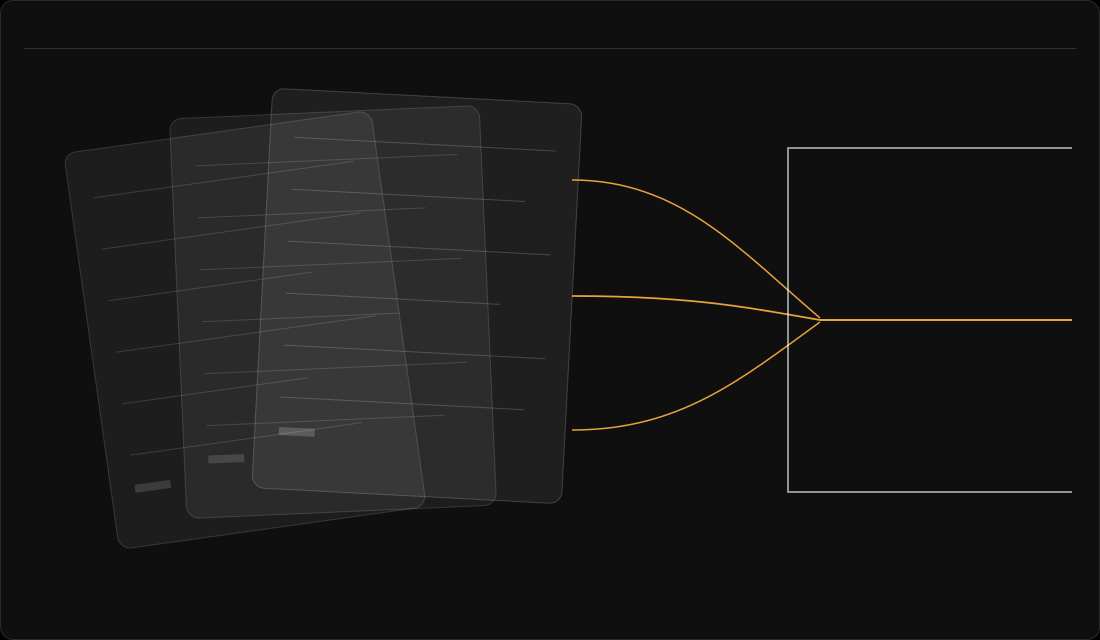
Picture a board meeting where someone asks about one AI tool on your list. Who looks after it, and when did anyone last check it? You open the AI register and find the tool, with its name and the team that uses it. The rest of the row is blank. That is the accountability gap. An AI register is the list plus the owner, the decision, the history and the evidence.
An AI register answers one question: what AI do we have? That matters, and it is where the work starts. Evidence is the answers around it, kept current: who owns each system, why it is used, what was assessed, and who confirmed it and when.
What does an AI register answer?
The AI register answers: What AI do we have?
The IIA, the professional body for internal auditors, updated its AI Auditing Framework in September 2024 [1]. It suggests internal auditors start with a simple question: "How is AI being used?" It calls building that picture a first step.
A list on its own is not yet governance, though. Accountancy Europe and ecoDa make the same point in a briefing paper for boards, published in October 2026 [2]. On their maturity scale, an inventory with clear ownership and risk classification is stage two, "mapped". Controls and assurance operating effectively come at stage three, "controlled". The paper adds that the scale is "not a checklist".
In ordinary language: governance has to operate.
Some organisations are also looking at ISO/IEC 42001:2023, which ISO describes as the world's first AI management system standard [3]. It is a voluntary standard that sets out what an AI management system should include. ISO describes the standard as specifying requirements for establishing, implementing, maintaining and continually improving an AI management system. That means the policies, objectives and processes an organisation uses for the responsible development, provision or use of AI.
Questions internal audit may ask about AI
Internal audit is the team that checks, independently, whether an organisation's controls work. We think nine questions follow the list, and an auditor, a board or a customer may ask any of them. Each has a published source that asks something similar, and we name who each source is for.
1. Who owns it?
MAS, Singapore's financial regulator, published AI risk management guidelines on 7 October 2026, which apply to Singapore financial institutions from 7 October 2027 [4]. They say the details kept on each AI use may include key roles, such as owners. The IIA's framework also suggests recording who manages each AI use and who oversees it [1].
2. Why is it being used?
The US NIST AI Risk Management Framework, a voluntary framework from January 2023, asks that intended purposes are understood and documented [5]. FINMA, Switzerland's financial supervisor, published guidance on 18 December 2024 about the institutions it supervises [6]. It looked for documentation of each material application's purpose.
3. Who may be affected?
The NIST framework asks organisations to weigh how likely and how large each impact is, on individuals, groups, communities, organisations and society [5]. A meeting-notes tool and a tool that helps decide loan applications give very different answers.
4. What risks and impacts have been assessed?
When FINMA reviewed AI at Swiss supervised institutions, it looked at how AI applications were risk-classified [6]. Accountancy Europe and ecoDa suggest boards ask whether they keep an up-to-date list of AI systems, use cases and their risk classifications [2].
5. Which controls apply, and why?
FINMA looked for a centrally managed list with a risk classification and the measures that result from it [6]. Accountancy Europe and ecoDa suggest audit and risk committees check one thing in particular [2]. Were controls adapted to AI, or "simply repackaged from pre-AI frameworks"? The "why" is our addition, because a control nobody can explain is hard to review.
6. What evidence shows those controls are working?
The IIA's Global Internal Audit Standards, issued in January 2024, describe the information internal auditors gather [7]. It has to be relevant, reliable and sufficient, and reliable means "factual and current". That standard binds the auditors who follow it, not the organisation being audited. It still shows what a careful auditor may look for.
7. What changed since the last review?
MAS expects Singapore financial institutions to update their AI records at a set frequency, to reflect new, updated or retired AI [4]. The NIST framework asks for periodic review, with its frequency decided in advance [5].
8. Who accepted the remaining risk?
MAS says the remaining risk of an AI use should meet the firm's risk appetite before it is deployed [4]. The NIST framework asks that negative residual risks are documented [5]. Neither source says who should accept that risk. That is a decision for each organisation, and it helps to write down who made it and when.
9. What happens when something goes wrong?
MAS expects senior management at Singapore financial institutions to set an internal escalation process for material AI risks and exceptions, such as AI incidents [4]. The NIST framework asks that processes for incidents and errors are followed and documented [5].

The hard part is keeping it current
The hard part is not creating each document once. The hard part is keeping the answers complete, current, connected and reviewable as AI systems, suppliers, models, people and regulations change.
A list that someone looks after can still be wrong. In December 2023, the US Government Accountability Office reviewed the AI use lists of 23 US federal agencies [8]. Of the 20 that reported AI uses, 5 gave comprehensive information, and the other 15 had instances of incomplete and inaccurate data. Two lists even included uses that the agencies later decided were not AI.
Those agencies keep their lists under a US federal duty, so this is not a rate for companies. It does show that a maintained list can drift, and suppliers add to the problem. FINMA noted that Swiss supervised institutions sometimes found it hard to tell whether a bought-in service included AI [6].
The missing middle
At one end is finding the AI in use, which starts with knowing how AI gets into a company. At the other end is telling a board, a customer or a supervisor that AI is governed. Between the two sits what we call the missing middle.
The middle holds owners, confirmations, risk and impact decisions, the controls that apply and the records behind them. It also holds changes, exceptions and reviews. Without it, a list stays a list and a report stays an assertion.
In our view, an entry holds up better when it carries four things: an owner, a source, a date and a confirmation. The owner is a named role, and the source says how the entry was found. The date shows when it was last true, and the confirmation records who checked it. No standard we read names these four as a set, so treat it as our reading of the sources.
The question to ask instead
Do not ask only: Do we have an AI policy?
Ask: Can we show
- which AI systems exist,
- who owns them,
- how their risks and impacts were assessed,
- which controls apply,
- what evidence supports our claims,
- what has changed
- and what management did about it?
If you want to test your own list against these questions, you can check what your AI list can show.
Questions people ask
Is an AI register evidence that AI is governed?
On its own, no. A register shows what AI an organisation has. Evidence of governance is the answers around it: who owns each system, what was assessed, which controls apply, and who confirmed them and when.
Does an AI register make an organisation compliant or ready for an audit?
No. A register on its own does not make an organisation compliant or ready for any audit.
What makes an entry in an AI register hold up?
In our view, four things: a named owner, a source, a date, and a confirmation of who checked it. No standard we read names these four as a set.
To move from a list to a record, with owners named and evidence kept, you can start here: Start your 7 days. The seven days end with a short report; the full record comes if you continue.
This piece is for orientation only and is not legal advice. Qualified counsel in your jurisdiction should confirm your position.
Moustr does not certify compliance with the EU AI Act, ISO/IEC 42001 or any other framework, and does not provide legal advice.
Sources
- The IIA (The Institute of Internal Auditors), Artificial Intelligence Auditing Framework, September 2024 update (13 September 2024), p. 8. Professional guidance for internal auditors, not a mandatory standard. Checked 31 October 2026.
- Accountancy Europe and ecoDa, AI governance: Ten principles for effective Board oversight, briefing paper, October 2026, pp. 11, 19 and 30. EU professional guidance for boards, not law. Checked 31 October 2026.
- ISO, ISO/IEC 42001:2023, ISO's public page (undated; standard published December 2023). Voluntary international standard: ISO's media kit (https://www.iso.org/media-kit.html) says "ISO standards are voluntary". Checked 31 October 2026.
- Monetary Authority of Singapore (MAS), Guidelines on Artificial Intelligence Risk Management, 7 October 2026, paras. 3.5, 4.5, 4.7 and 4.11. For Singapore financial institutions; takes effect 7 October 2027. Checked 31 October 2026.
- NIST (US Department of Commerce), AI Risk Management Framework 1.0, NIST AI 100-1, January 2023: GOVERN 1.5, MAP 1.1, MAP 5.1, MANAGE 1.4 and MANAGE 4.3. Voluntary US framework. Checked 31 October 2026.
- FINMA (Swiss Financial Market Supervisory Authority), Guidance 08/2024, Governance and risk management when using artificial intelligence, 18 December 2024, sections 2.1, 2.2 and 2.5. Supervisory observations about Swiss supervised financial institutions. Checked 31 October 2026.
- The IIA, Global Internal Audit Standards, issued 9 January 2024, Standard 14.1, pp. 104 to 105. Binds internal auditors who follow the Standards, not the audited organisation. Checked 31 October 2026.
- US Government Accountability Office, GAO-24-105980, Artificial Intelligence: Agencies Have Begun Implementation but Need to Complete Key Requirements, 12 December 2023. About US federal agencies, not companies. Checked 31 October 2026.
Last updated: 2 November 2026